
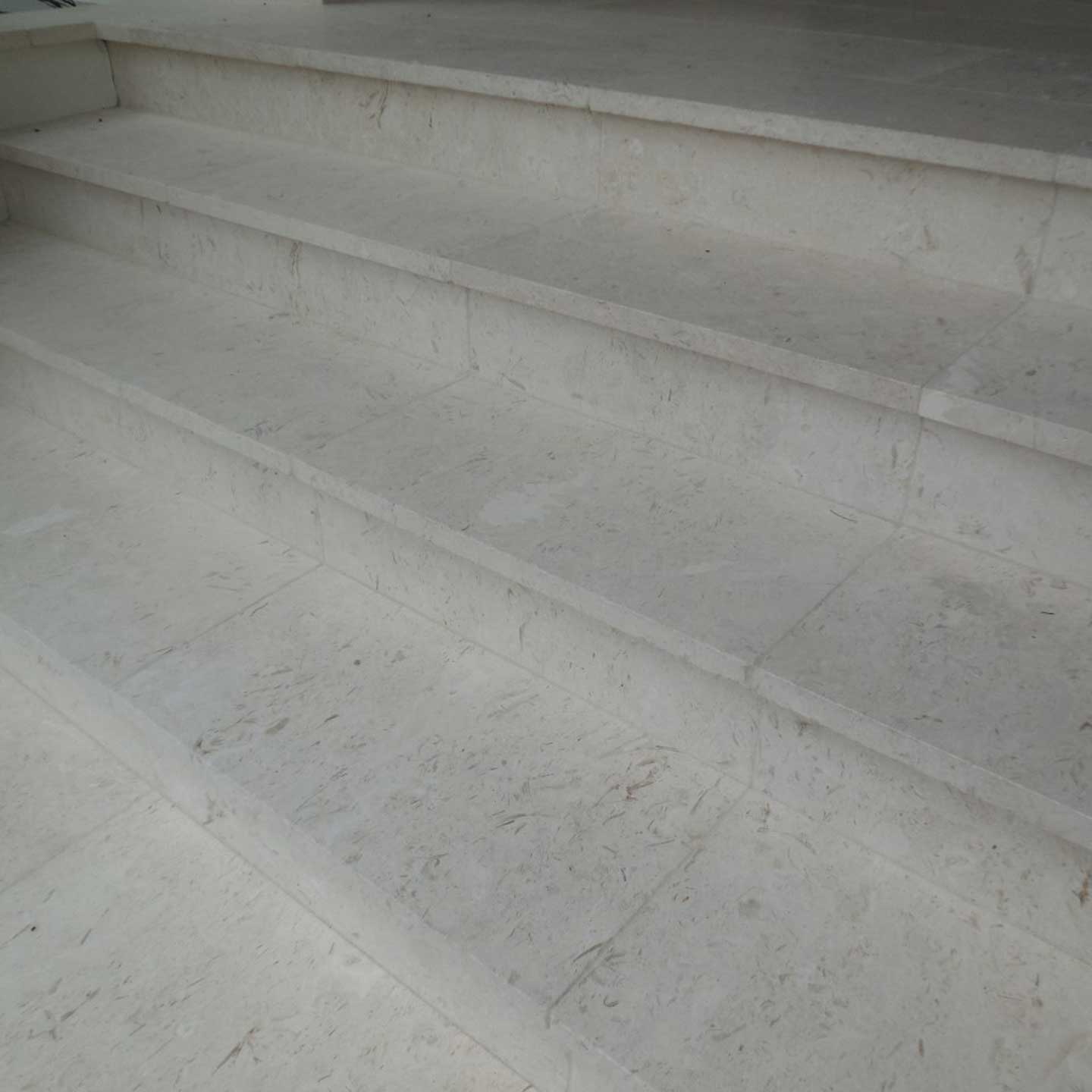

Limestone Stairs for Interior and Exterior Architectural Projects
DMR Limestone manufactures custom limestone stairs for villas, hotels, resorts, commercial buildings, gardens, pool areas, landscape projects and luxury residential developments worldwide.
Produced from carefully selected Turkish limestone, our stair components can be manufactured according to architectural drawings, staircase dimensions, surface finish requirements and project-specific installation details.
Limestone stairs provide a refined natural stone appearance for both contemporary and traditional architecture. White, cream and beige limestone can be used to create bright entrance steps, elegant interior staircases, garden stairs, hotel stairways and coordinated exterior landscape elements.
A complete limestone staircase package may include:
- Limestone stair treads
- Limestone risers
- Stair landings
- Step nosings
- Skirting pieces
- Stringer cladding
- Winder steps
- Curved stair components
- Bullnose steps
- Mitred steps
- Solid block steps
- Stair coping
- Matching balustrades
- Numbered installation pieces
DMR Limestone works with architects, contractors, developers, villa builders, hotel developers, landscape designers, importers and natural stone distributors.
What Are Limestone Stairs?
Limestone stairs are staircase components manufactured from natural limestone.
Depending on the project, limestone may be used as:
- Treads installed over reinforced concrete stairs
- Risers installed on vertical stair faces
- Solid block steps
- Cladding over a steel staircase
- Landscape steps
- Garden stair units
- Entrance steps
- Pool-area stairs
- Curved staircase components
- Monumental architectural stairs
Limestone stair systems may be produced from slabs, thick stone pieces or solid blocks according to the design and expected use.
For projects requiring custom dimensional production, explore our cut to size limestone service.
Why Choose Limestone Stairs?
Limestone provides a natural, elegant and architecturally versatile material for staircases.
The main advantages of limestone stairs include:
- Timeless natural stone appearance
- Suitable for interior and exterior projects
- White, cream and beige colour options
- Custom tread and riser dimensions
- Multiple edge-profile options
- Smooth or textured surface finishes
- Compatibility with modern and traditional architecture
- Matching landings and skirting
- Coordination with flooring and wall cladding
- Suitable for villas, hotels and commercial projects
- Suitable for garden and landscape stairs
- Manufactured according to project drawings
- Available in straight, curved and winder formats
- Long service life when correctly specified and installed
Limestone stairs can be coordinated with limestone tiles, limestone pavers and limestone balustrades to create a consistent natural stone design.
Turkish Limestone Stairs
Turkey is internationally recognised for natural stone quarrying and architectural stone processing.
Turkish limestone is suitable for stair production because of its:
- Natural white, cream and beige tones
- Architectural workability
- Suitability for precision cutting
- Compatibility with edge profiling
- Ability to receive textured finishes
- Availability in custom thicknesses
- Compatibility with interior and exterior design
- Suitability for project-based production
DMR Limestone supplies Turkish limestone stairs for international residential, hospitality, commercial and landscape projects.
Production can be organised according to:
- Stair plans
- Stair sections
- Tread schedules
- Riser dimensions
- Landing dimensions
- Nosing profiles
- Surface finish requirements
- Stair numbering
- Installation sequence
- Packaging instructions
Learn more about our stone range on the Turkish limestone page.
White Limestone Stairs
White limestone stairs create a bright, clean and refined architectural appearance.
They are frequently selected for:
- Luxury villas
- Coastal residences
- Hotel entrances
- Modern interior staircases
- Mediterranean architecture
- Pool houses
- Garden stairs
- Contemporary commercial buildings
- Luxury residential projects
White limestone works well with:
- Glass balustrades
- Black metal railings
- Natural timber
- Bronze details
- White rendered walls
- Large windows
- Minimalist interiors
- Coordinated limestone flooring
DMR Limestone supplies selected white limestone options for treads, risers, landings and custom stair elements.
Natural fossils, pores and colour variation are part of the authentic character of limestone.
Limra Limestone Stairs
Limra limestone is a light cream to white natural stone quarried in the Antalya region of Turkey.
Its light colour and architectural workability make it suitable for:
- Interior stair treads
- Exterior entrance steps
- Villa staircases
- Hotel stairs
- Garden steps
- Landing slabs
- Stair skirting
- Curved stair components
- Matching balustrade bases
Limra limestone can be manufactured with honed, brushed, sandblasted or project-specific surface finishes.
The correct finish should be selected according to whether the stair is used indoors, outdoors or in a wet area.
Beige Limestone Stairs
Beige limestone stairs provide a warmer and more traditional architectural appearance.
They are suitable for:
- Mediterranean villas
- Country houses
- Traditional hotels
- Courtyard stairs
- Garden landscapes
- Classical residences
- Restoration projects
- Warm-toned interiors
Beige limestone works well with timber, bronze, terracotta, warm render colours and natural landscaping.
Explore our beige limestone page.
Interior Limestone Stairs
Interior limestone stairs can become a central architectural feature within a villa, hotel, office or commercial building.
Common applications include:
- Main villa staircases
- Hotel lobby stairs
- Entrance hall stairs
- Office staircases
- Restaurant interiors
- Luxury apartment stairs
- Spa interiors
- Reception areas
- Formal residential spaces
Interior stair components may include:
- Honed limestone treads
- Matching risers
- Large landing slabs
- Limestone skirting
- Wall stringer cladding
- Custom nosing profiles
- Matching limestone balustrades
A coordinated interior can combine the staircase with limestone tiles, limestone slabs and limestone fireplace surrounds.
Exterior Limestone Stairs
Exterior limestone stairs are used for entrances, gardens, terraces, pool areas and landscape architecture.
Applications include:
- Villa entrance steps
- Hotel entrance stairs
- Garden steps
- Terrace stairs
- Pool-house steps
- Courtyard stairs
- Commercial building entrances
- Landscape level changes
- Exterior walkways
- Retaining-wall stairs
Exterior stairs require careful consideration of:
- Slip resistance
- Drainage
- Freeze-thaw exposure
- Water absorption
- Step slope
- Nosing design
- Installation system
- Substrate
- Joint layout
- Local safety regulations
Textured finishes such as brushed or sandblasted limestone may be selected where additional surface grip is required.
Limestone Entrance Steps
Limestone entrance steps create a strong first impression at villas, hotels, commercial buildings and public entrances.
Entrance step systems may include:
- Wide front steps
- Multiple tread-and-riser units
- Side return pieces
- Landing slabs
- Curved entrance steps
- Mitred corners
- Solid block steps
- Matching door thresholds
- Matching balustrade posts
- Coordinated façade elements
Entrance stairs can be coordinated with:
- Limestone door and window frames
- Limestone facade panels
- Limestone pavers
- Limestone columns
- Limestone balustrades
Limestone Stairs for Villas
Limestone stairs are widely used throughout luxury villa projects.
Possible applications include:
- Main entrance steps
- Interior staircases
- Garden stairs
- Pool-area steps
- Terrace connections
- Courtyard stairs
- Basement entrances
- Balcony stairs
- Guest-house stairs
- Roof-terrace access
For a coordinated villa project, limestone stairs may be combined with:
- Limestone pavers
- Limestone pool coping
- Limestone balustrades
- Limestone wall cladding
- Limestone window sills
- Limestone wall caps
Visit our villa facades and luxury residential projects pages.
Limestone Stairs for Hotels and Resorts
Hotels and resorts often require coordinated stone stairs across several areas of the development.
Applications may include:
- Main entrance stairs
- Lobby staircases
- Guestroom-block stairs
- Spa entrances
- Restaurant terraces
- Pool-area steps
- Garden walkways
- Courtyard stairs
- Conference buildings
- Resort villas
DMR Limestone can manufacture repeated stair components with controlled:
- Tread dimensions
- Riser heights
- Surface finishes
- Nosing profiles
- Landing sizes
- Piece numbers
- Staircase references
- Packaging sequences
Learn more about our hotel and resort projects solutions.
Limestone Stairs for Commercial Buildings
Limestone stairs can create a professional and durable natural stone appearance for commercial architecture.
Suitable applications include:
- Office entrances
- Corporate headquarters
- Retail buildings
- Restaurants
- Showrooms
- Cultural buildings
- Mixed-use developments
- Institutional buildings
- Commercial courtyards
Commercial staircases should be specified according to:
- Pedestrian traffic
- Slip resistance
- Accessibility requirements
- Stair geometry
- Edge visibility
- Maintenance
- Structural support
- Local building regulations
Visit our commercial buildings page.
Limestone Garden Steps
Limestone garden steps help connect different landscape levels while maintaining a natural architectural appearance.
Applications include:
- Garden pathways
- Sloped landscapes
- Courtyards
- Villa gardens
- Resort landscapes
- Water-feature access
- Raised terraces
- Formal gardens
- Entrance landscapes
- Stepping-stone stairways
Garden steps may be produced as:
- Solid block steps
- Tread-and-riser units
- Long landscape steps
- Random-width steps
- Curved steps
- Irregular natural-style steps
- Wide platform steps
Explore our garden pathways and landscape architecture pages.
Limestone Pool Steps
Limestone may be used for steps around pool areas, pool houses and elevated pool terraces.
Applications may include:
- Pool-deck stairs
- Terrace steps
- Pool-house entrance steps
- Landscape stairs near pools
- Integrated external pool steps
- Raised coping transitions
Pool-area stairs should consider:
- Wet-area slip resistance
- Drainage
- Pool chemicals
- Surface finish
- Edge profile
- Maintenance
- Local pool-safety requirements
Matching limestone pool coping and limestone pavers can create a continuous pool-surround design.
Limestone Stair Treads
The tread is the horizontal surface of a stair step.
Limestone stair treads can be manufactured in:
- Straight rectangular formats
- Custom widths
- Custom depths
- Long continuous pieces
- Split sections
- Curved shapes
- Winder shapes
- Thick block formats
- Mitred box formats
- Bullnose formats
Tread design should consider:
- Finished stair width
- Required going
- Nosing projection
- Surface finish
- Support conditions
- Slip resistance
- Edge profile
- Staircase geometry
Limestone Risers
The riser is the vertical face between two stair treads.
Limestone risers may be produced with:
- Matching limestone
- Contrasting limestone
- Smooth honed finish
- Textured finish
- Mitred joints
- Recessed shadow joints
- Decorative profiles
- Custom heights
Risers can be coordinated with the tread colour and finish or used as a contrasting design element.
Limestone Stair Landings
Landing areas connect stair flights and provide level platforms.
Limestone landing components may include:
- Large-format slabs
- Multiple coordinated panels
- Border pieces
- Wall skirting
- Stair-transition pieces
- Matching floor tiles
- Custom-shaped landings
Landing dimensions should be coordinated with:
- Stair width
- Building circulation
- Door openings
- Balustrades
- Floor finishes
- Movement joints
For large landing pieces, explore our limestone slabs page.
Limestone Stair Nosings
The nosing is the front edge of the stair tread.
Nosing profiles influence both appearance and user safety.
Available options may include:
- Straight square edge
- Small bevel
- Large bevel
- Pencil edge
- Full bullnose
- Half bullnose
- Rounded edge
- Chamfered edge
- Ogee profile
- Rebated nosing
- Projecting classical profile
- Anti-slip grooved nosing
The selected nosing should consider:
- Interior or exterior use
- Visibility
- Slip resistance
- Accessibility requirements
- Design style
- Tread thickness
Bullnose Limestone Steps
Bullnose steps have a rounded front edge.
They are frequently used for:
- Villa entrance steps
- Pool-area steps
- Garden stairs
- Traditional interiors
- Mediterranean projects
- Curved staircases
Bullnose profiles may be:
- Full bullnose
- Half bullnose
- Soft rounded edge
- Double bullnose
- Custom moulded profile
Mitred Limestone Steps
Mitred steps are fabricated by joining the tread and riser at a 45-degree angle.
This creates the appearance of a thicker solid stone step.
Advantages include:
- Clean contemporary appearance
- Flexible visual thickness
- Concealed joint at the front edge
- Large monolithic appearance
- Compatibility with minimalist design
Mitred steps require accurate factory fabrication and professional installation.
Solid Limestone Steps
Solid limestone steps are produced from thick stone blocks.
They are suitable for:
- Garden steps
- Landscape stairs
- Entrance stairs
- Monumental stairs
- Heavy architectural designs
- Traditional masonry projects
Solid steps may provide:
- Strong visual weight
- Reduced number of joints
- Natural block appearance
- Simplified landscape installation
However, solid steps can be extremely heavy and may require cranes, lifting equipment and engineered foundations.
Boxed Limestone Steps
Boxed steps create the visual appearance of thick solid stone using separately fabricated stone panels.
A boxed step may include:
- Top tread
- Front riser
- Side return
- Mitred joints
- Hidden substrate
- Reinforced internal support
This method is suitable for modern villas and luxury interiors where a monolithic appearance is required without using a full solid block.
Floating Limestone Stairs
Floating stairs create the appearance that individual treads are suspended or projecting from a wall.
Limestone floating treads may be supported by:
- Concealed steel structures
- Reinforced concrete
- Cantilever brackets
- Central steel spines
- Engineered wall supports
Floating limestone stairs require detailed structural engineering.
The stone thickness, internal reinforcement and fixing system must be designed for the expected loads.
Limestone Stairs over Reinforced Concrete
One of the most common applications is limestone cladding over a reinforced-concrete staircase.
The system may include:
- Limestone treads
- Limestone risers
- Adhesive or mortar bed
- Mechanical support where required
- Stair skirting
- Landing panels
- Joint material
The concrete substrate should be:
- Structurally sound
- Correctly dimensioned
- Clean
- Level
- Dry enough for installation
- Prepared for natural stone fixing
Inaccurate concrete stair geometry can create problems during stone installation.
Limestone Stairs over Steel Structures
Limestone can be installed over engineered steel stair systems.
Possible applications include:
- Modern interior stairs
- Floating staircases
- Commercial stairs
- Hotel feature stairs
- Cantilevered steps
Steel-supported stairs require coordination of:
- Tread thickness
- Stone reinforcement
- Support plate dimensions
- Deflection
- Vibration
- Adhesive compatibility
- Mechanical fixing
- Movement isolation
The steel structure must be designed to limit movement that could crack the limestone.
Curved Limestone Stairs
Curved staircases require project-specific geometry and numbered stone components.
Curved stair production may include:
- Radius treads
- Curved risers
- Winder steps
- Curved skirting
- Curved landing pieces
- Matching balustrade components
- Inner and outer stringer cladding
Accurate production requires:
- CAD drawings
- Stair centreline
- Inner and outer radii
- Rise and going dimensions
- Full stair plan
- Sections
- 3D models
- Piece numbering
Spiral Limestone Stairs
Spiral and helical staircases can use custom limestone treads manufactured in wedge-shaped formats.
Components may include:
- Winder treads
- Central-column openings
- Curved outer edges
- Custom nosings
- Numbered installation sequence
- Curved skirting
- Matching balustrade bases
Spiral stairs require detailed coordination with the structural system and handrail design.
Winder Limestone Steps
Winder steps change direction without using a rectangular landing.
They are usually triangular or trapezoidal.
Production requires:
- Exact inner width
- Exact outer width
- Step angle
- Nosing geometry
- Riser position
- Stair direction
- Piece numbering
Each winder step should be clearly identified according to its installation location.
Limestone Stair Skirting
Stair skirting is installed along the wall beside a staircase.
Options may include:
- Straight stepped skirting
- Continuous sloped skirting
- Individual tread-and-riser pieces
- Moulded skirting
- Minimal rectangular skirting
- Decorative classical profiles
Skirting helps:
- Protect walls
- Finish the stair edge
- Coordinate with flooring
- Create a complete stone design
- Hide installation joints
Limestone Stair Stringer Cladding
The side face of a staircase may be clad with limestone.
Stringer cladding can be:
- Straight
- Stepped
- Sloped
- Curved
- Mitred with treads
- Integrated with balustrade bases
- Designed as a monolithic side panel
This detail is often used in luxury villas and hotel interiors.
Limestone Stair Surface Finishes
The correct surface finish depends on the staircase location and expected conditions.
Honed Limestone Stairs
Honed limestone has a smooth, matte appearance.
It is suitable for:
- Interior staircases
- Hotel lobbies
- Luxury villas
- Commercial interiors
- Modern stair designs
Honed surfaces should be evaluated carefully in wet or highly polished conditions because slip resistance may be reduced.
Brushed Limestone Stairs
Brushed limestone has a lightly textured surface.
It is suitable for:
- Exterior entrance steps
- Garden stairs
- Covered terraces
- Mediterranean villas
- Interior stairs requiring more texture
Sandblasted Limestone Stairs
Sandblasted limestone creates a textured, non-reflective surface.
It is commonly selected for:
- Exterior stairs
- Pool-area steps
- Commercial entrances
- Garden stairs
- Hotel exteriors
- Wet or exposed areas
Tumbled Limestone Stairs
Tumbled limestone has softened edges and an aged appearance.
It is suitable for:
- Mediterranean villas
- Garden stairs
- Traditional interiors
- Courtyards
- Restoration projects
Bush-Hammered Limestone Stairs
Bush hammering creates a rough and evenly textured surface.
It may be selected for:
- Exterior commercial stairs
- Landscape stairs
- High-grip entrance areas
- Garden steps
- Large public staircases
Chiselled Limestone Stairs
Chiselled textures may be applied to:
- Riser faces
- Step edges
- Garden stairs
- Rustic architecture
- Restoration projects
The walking surface should remain comfortable and appropriate for the intended use.
Anti-Slip Limestone Stair Treatments
Slip resistance is especially important for exterior, wet and commercial stairs.
Possible solutions include:
- Sandblasted surfaces
- Brushed surfaces
- Bush-hammered surfaces
- Anti-slip grooves
- Textured strips
- Contrasting inserts
- Surface treatments approved for limestone
- Roughened nosing areas
The final solution should comply with local regulations and project-specific slip-resistance requirements.
Anti-Slip Grooves
Grooves can be cut near the front edge of limestone stair treads.
Options may include:
- One continuous groove
- Multiple parallel grooves
- Wide recessed strips
- Narrow saw-cut grooves
- Inlaid anti-slip strips
- Contrasting stone inserts
Grooves should be designed to avoid:
- Weakening the front edge
- Collecting excessive dirt
- Trapping water
- Creating uncomfortable walking surfaces
Limestone Stair Dimensions
Important stair dimensions include:
- Stair width
- Tread depth
- Riser height
- Nosing projection
- Stone thickness
- Landing dimensions
- Stair angle
- Winder geometry
- Balustrade location
- Skirting height
- Joint width
The staircase geometry must comply with local regulations and be confirmed by the project architect or engineer.
DMR Limestone manufactures the stone according to approved dimensions but does not determine the legal stair geometry.
Limestone Stair Tread Thickness
Possible tread thicknesses may include:
- 20 mm
- 30 mm
- 40 mm
- 50 mm
- 60 mm
- Greater custom thicknesses
The required thickness depends on:
- Support conditions
- Tread span
- Stair design
- Interior or exterior use
- Edge profile
- Expected traffic
- Stone characteristics
- Structural system
- Visual requirements
Floating or unsupported steps may require substantially different engineering from stone installed over concrete.
Limestone Stair Width and Length
Long stair treads may be produced as one piece or divided into sections.
The final decision depends on:
- Quarry block dimensions
- Slab dimensions
- Stone strength
- Tread thickness
- Transport limitations
- Installation access
- Structural support
- Risk of breakage
Large entrance stairs may use multiple aligned tread pieces to achieve the required width.
Matching Limestone Balustrades
Limestone stairs can be combined with matching limestone balustrades.
A coordinated system may include:
- Stair balusters
- Sloped top rails
- Sloped bottom rails
- Newel posts
- Landing posts
- Stair caps
- Tread-side details
- Pier caps
Explore our limestone balustrades page.
Limestone Stairs with Glass Railings
Modern limestone stairs are often combined with glass balustrades.
The design should coordinate:
- Glass channel positions
- Fixing holes
- Edge distances
- Stone thickness
- Concealed steel supports
- Drainage for exterior systems
- Tread dimensions
- Handrail locations
Fixing glass directly through limestone requires professional engineering to avoid cracking or edge failure.
Limestone Stairs with Metal Railings
Limestone stairs can also be combined with:
- Black steel railings
- Stainless-steel handrails
- Bronze railings
- Wrought-iron balustrades
- Aluminium systems
Metal posts may be fixed through or beside the stone.
Fixing points should be coordinated before stone production.
Limestone Stair Lighting
Lighting can be integrated into limestone stair design.
Options include:
- LED strips beneath nosings
- Recessed step lights
- Wall-mounted lighting
- Integrated riser lights
- Lighting channels in side panels
- Illuminated handrails
Stone production may require:
- Cable channels
- Recesses
- Cut-outs
- Light housings
- Access panels
- Numbered components
Lighting details should be finalised before fabrication.
Limestone Stairs and Interior Flooring
Interior limestone stairs can be manufactured to match surrounding floor tiles or slabs.
This creates continuity between:
- Entrance halls
- Staircases
- Landings
- Corridors
- Living areas
- Hotel lobbies
For related products, explore:
- Limestone tiles
- Limestone slabs
- Interior flooring
Limestone Stairs and Exterior Paving
Exterior stairs can be coordinated with limestone paving to connect terraces, entrances and garden areas.
A coordinated package may include:
- Entrance steps
- Landing pavers
- Garden pathways
- Pool surrounds
- Terrace paving
- Wall caps
- Balustrades
Explore our limestone pavers and garden pathways pages.
Limestone Stairs for Restoration Projects
Historic and traditional staircases may require custom replacement components.
Restoration work may include:
- Replacing damaged treads
- Reproducing original nosing profiles
- Matching existing limestone
- Manufacturing new risers
- Recreating curved steps
- Producing aged surfaces
- Matching stair skirting
- Reproducing monumental entrance stairs
- Repairing worn landing stones
Production references may include:
- Existing tread samples
- Site measurements
- Historic drawings
- Profile templates
- Photographs
- 3D scans
- Approved restoration samples
Visit our restoration projects page.
Cut to Size Limestone Stair Production
DMR Limestone can manufacture stair components according to architectural cutting lists and shop drawings.
Our cut to size limestone services may include:
- Tread cutting
- Riser cutting
- Landing production
- Nosing profiling
- Mitre cutting
- Bullnose processing
- Anti-slip grooves
- Drilling
- Rebates
- Notches
- Curved cutting
- Winder-step production
- Skirting production
- Piece numbering
Factory fabrication reduces on-site cutting and helps maintain consistent dimensions.
CNC Limestone Stair Production
CNC machinery can be used for:
- Curved stair treads
- Winder steps
- Custom nosings
- Anti-slip grooves
- Mitred components
- Stair skirting
- Recesses
- Lighting channels
- Fixing holes
- Repeated tread types
Benefits include:
- Dimensional accuracy
- Consistent edge profiles
- Efficient repeated production
- Compatibility with CAD drawings
- Reduced site modification
- Accurate curved geometry
Limestone Stair Installation
Installation should be completed by experienced natural stone contractors.
A typical installation process may include:
- Checking the structural staircase
- Verifying rise and going dimensions
- Confirming piece numbers
- Preparing the substrate
- Installing risers where applicable
- Installing treads
- Checking slope and level
- Aligning nosings
- Installing landings
- Installing skirting
- Completing joints
- Cleaning and protecting the stone
Installation products should be suitable for natural limestone.
Limestone Stair Fixing Systems
Possible fixing methods include:
- Natural stone adhesive
- Mortar beds
- Mechanical anchors
- Stainless-steel pins
- Hidden brackets
- Steel support plates
- Combination fixing
- Structural grout
The correct fixing system depends on:
- Stair type
- Stone thickness
- Substrate
- Interior or exterior use
- Tread span
- Structural movement
- Expected loads
Floating and cantilevered stairs require specialist structural engineering.
Limestone Stair Joints
Joints may occur between:
- Treads and risers
- Long tread sections
- Landings
- Skirting pieces
- Curved stair segments
- Stair and floor finishes
- Stair and wall cladding
Joint design should consider:
- Structural movement
- Installation tolerances
- Water exposure
- Visual alignment
- Mortar or sealant colour
- Maintenance
- Replacement access
Mitred joints can create a more monolithic appearance, while expressed joints may support movement and easier installation.
Water Drainage on Exterior Stairs
Exterior stair treads should not allow water to collect.
Drainage considerations include:
- Slight outward slope
- Open side drainage
- Joint design
- Landing drainage
- Waterproofing beneath stone
- Drip edges
- Nosing details
- Drain channels
- Snow and ice conditions
Standing water may increase staining, biological growth and freeze-thaw risk.
Limestone Stairs in Cold Climates
Cold-climate projects should evaluate:
- Freeze-thaw resistance
- Water absorption
- Tread drainage
- Joint saturation
- Ice formation
- Snow accumulation
- De-icing salts
- Substrate movement
- Adhesive suitability
De-icing chemicals may damage limestone or cause staining. Product compatibility should be confirmed before use.
Limestone Stairs in Coastal Projects
Coastal stairs may be exposed to:
- Salt spray
- High humidity
- Wind-driven rain
- Intense sunlight
- Frequent wetting and drying
- Corrosive conditions
Suitable surface finishes, corrosion-resistant fixings and regular maintenance should be considered.
Limestone Stair Sealing and Maintenance
Depending on the application, limestone stairs may benefit from a breathable natural stone sealer.
Maintenance recommendations include:
- Use pH-neutral stone cleaners
- Avoid acidic products
- Clean spills promptly
- Remove dirt from anti-slip grooves
- Inspect exterior joints
- Maintain drainage
- Avoid harsh de-icing chemicals
- Repair loose components
- Avoid aggressive pressure washing
- Test cleaning products before full use
Acidic cleaners can etch limestone and alter the surface finish.
Limestone Stair Production Process
A typical production process may include:
- Review of stair drawings
- Confirmation of staircase dimensions
- Limestone selection
- Preparation of cutting lists
- Sample and finish approval
- Slab or block cutting
- Tread and riser cutting
- Edge profiling
- Surface finishing
- Anti-slip groove production
- Curved or winder-step machining
- Dimension inspection
- Piece numbering
- Trial layout
- Protective packaging
For complex staircases, a complete digital model or shop-drawing set may be required.
Limestone Stair Quality Control
Quality-control procedures may include:
- Limestone selection
- Colour-range review
- Length and width checks
- Thickness control
- Tread-depth verification
- Riser-height verification
- Nosing-profile inspection
- Anti-slip groove checks
- Surface-finish review
- Curved-geometry inspection
- Piece-number control
- Packaging inspection
Natural fossil and colour variation should be managed according to approved samples.
Limestone Stair Packaging
Stair components require careful packaging because tread edges and nosings can be vulnerable during transport.
Packaging may include:
- Reinforced wooden crates
- Foam separators
- Edge protectors
- Nosing protection
- Vertical or horizontal supports
- Piece labels
- Stair-flight identification
- Floor-level references
- Installation-sequence numbers
- Crate lists
Winder, curved and custom pieces may require individual supports.
Limestone Stairs for Architects
DMR Limestone supports architects with project-specific stair production.
Support may include:
- Limestone selection
- Surface finish samples
- Nosing-profile development
- Tread-thickness evaluation
- Curved-stair fabrication
- Landing coordination
- Balustrade integration
- Full-size samples
- Drawing-based manufacturing
- Piece numbering
- Packaging planning
Architects can provide:
- Stair plans
- Stair sections
- Tread schedules
- Landing details
- Balustrade details
- CAD files
- 3D models
- Finish schedules
- Quantity lists
Visit our dedicated architects page.
Limestone Stairs for Contractors
Contractors require accurate dimensions, installation references and dependable packaging.
Quotation information should include:
- Number of stair flights
- Number of steps
- Tread dimensions
- Riser dimensions
- Landing dimensions
- Tread thickness
- Nosing profile
- Surface finish
- Stair width
- Curved or winder pieces
- Skirting requirements
- Anti-slip requirements
- Project location
- Delivery destination
- Production schedule
Visit our contractors page.
Limestone Stairs for Importers and Stone Distributors
DMR Limestone supplies standard and custom limestone stair components to importers, distributors, fabricators and architectural stone contractors.
Orders may include:
- Standard stair treads
- Custom treads
- Risers
- Landing slabs
- Bullnose steps
- Solid landscape steps
- Curved treads
- Winder steps
- Stair skirting
- Matching balustrades
- Mixed architectural stone products
Related products include:
- Limestone slabs
- Limestone tiles
- Limestone pavers
- Limestone balustrades
- Cut to size limestone
Visit our importers and stone distributors pages.
Why Choose DMR Limestone?
DMR Limestone manufactures project-specific Turkish natural stone products for international architectural projects.
Our limestone stair capabilities include:
- Interior limestone stairs
- Exterior limestone stairs
- Entrance steps
- Garden steps
- Pool-area stairs
- Stair treads
- Risers
- Landings
- Bullnose steps
- Mitred steps
- Solid block steps
- Curved steps
- Winder steps
- Stair skirting
- Anti-slip grooves
- White, cream and beige limestone
- CNC production
- Drawing-based manufacturing
- Piece-numbered production
- Export-oriented packaging
From individual villa entrance steps to complete hotel stair systems, DMR Limestone can manufacture limestone stairs according to project-specific architectural requirements.
Frequently Asked Questions About Limestone Stairs
Is limestone suitable for stairs?
Yes. Limestone is widely used for interior and exterior stairs when the correct stone, thickness, finish and installation system are selected.
Can limestone stairs be used outdoors?
Yes. Exterior limestone stairs should use a suitable finish, drainage design, thickness and installation system according to the climate and traffic conditions.
Can limestone be used for interior staircases?
Yes. Honed limestone is frequently used for villa, hotel and commercial interior staircases.
Can you manufacture custom stair treads?
Yes. DMR Limestone can manufacture treads according to project-specific lengths, widths, thicknesses and edge profiles.
Can you manufacture matching risers?
Yes. Matching or contrasting limestone risers can be produced according to the staircase design.
Can you produce limestone stair landings?
Yes. Landings can be produced as large slabs or coordinated cut-to-size panels.
Can limestone stairs have bullnose edges?
Yes. Full bullnose, half bullnose and custom rounded nosings can be produced.
Can you produce mitred limestone steps?
Yes. Treads and risers can be mitred to create the appearance of thicker monolithic steps.
Can you produce solid limestone steps?
Yes. Solid block steps can be manufactured for garden, landscape and entrance applications, depending on block availability and transport conditions.
Can you manufacture curved limestone steps?
Yes. Curved treads, risers and landing pieces can be produced according to radius drawings or 3D models.
Can you manufacture spiral staircase treads?
Yes. Wedge-shaped and curved treads can be produced for spiral and helical staircases.
Can you produce winder steps?
Yes. Trapezoidal and triangular winder steps can be manufactured and numbered according to the stair plan.
Can limestone be used for floating stairs?
Yes, but floating limestone stairs require engineered steel or reinforced-concrete support. The stone and support system must be professionally designed.
Which limestone finishes are best for exterior stairs?
Brushed, sandblasted and bush-hammered finishes are often considered for exterior stairs because they provide more texture than smooth finishes.
Can anti-slip grooves be added?
Yes. One or more anti-slip grooves can be machined near the front edge of the tread.
Is honed limestone slippery?
Honed limestone is smoother than textured finishes. Its suitability depends on the application, moisture conditions and required slip resistance.
What thickness should limestone stair treads have?
The required thickness depends on the support system, tread size, span, edge profile, traffic and stone characteristics. There is no single thickness suitable for every project.
Can limestone stairs be used in cold climates?
Selected limestone may be suitable, but freeze-thaw resistance, drainage, water absorption and installation details must be evaluated.
Can limestone stairs be used near swimming pools?
Yes, provided the finish, slip resistance, drainage and maintenance plan are suitable for wet conditions.
Can limestone stairs match limestone flooring?
Yes. Treads, risers and landings can be manufactured to match limestone tiles, slabs or pavers.
Can limestone stairs be combined with stone balustrades?
Yes. Matching balusters, rails, newel posts and stair components can be manufactured.
Can limestone stairs be combined with glass railings?
Yes. Glass systems can be integrated when fixing positions, stone thickness and structural support are professionally coordinated.
Can you produce stair skirting?
Yes. Stepped, sloped, curved and custom limestone skirting can be manufactured.
Do limestone stairs need sealing?
Sealing depends on the stone, finish and application. A suitable breathable natural stone sealer may help reduce staining.
How should limestone stairs be cleaned?
Use pH-neutral natural stone cleaners. Avoid acidic products, harsh chemicals and incompatible de-icing salts.
Can each stair component be numbered?
Yes. Treads, risers, landings, skirting and curved pieces can be marked according to the stair flight and installation sequence.
How are limestone stairs packaged?
Stair components are packed in reinforced wooden crates with foam separation, nosing protection, piece labels and project-specific identification.
What information is required for a quotation?
Please provide:
- Stair plans and sections
- Number of steps
- Tread dimensions
- Riser dimensions
- Stair width
- Landing sizes
- Required stone thickness
- Nosing profile
- Surface finish
- Anti-slip requirements
- Curved or winder-step drawings
- Skirting requirements
- Preferred limestone
- Required quantity
- Delivery destination
Request Limestone Stair Samples and Pricing
Are you planning limestone stairs for a villa, hotel, resort, garden, pool area or commercial building?
Contact DMR Limestone to request:
- Limestone material samples
- White and Limra limestone options
- Surface finish samples
- Custom stair treads
- Matching risers
- Landing slabs
- Bullnose and mitred steps
- Solid landscape steps
- Curved and winder steps
- Anti-slip grooves
- Stair skirting
- Matching limestone balustrades
- Piece-numbered production
- Export packaging information
- Project-specific pricing
Send us your stair plans, sections, tread dimensions, surface finish requirements and delivery destination to receive a customised limestone stair quotation.